THE RECTORY MURDER.
Nick Carter paused only a moment before replying. He took that one moment to consider the other strange matter that had brought him to Washington, and whether compliance with the request just made by the chief of police would seriously interfere with it. He decided that it would not, and he then said quite gravely:
“Why, yes, I will go with Detective Fallon, since you both press me so earnestly. It is barely possible, chief, as you say, that I may detect something that would escape his notice. Who is the victim of the crime, if such it proves to be?”
“There is no question about that, Nick,” said the chief. “The murdered man is the Reverend Father Cleary, of the St. Lawrence Church. He was found dead on the floor of his library in the rectory, which adjoins the church, about half an hour ago.”
“A Roman Catholic priest, eh?”
“Yes.”
“What do you know about it?”
“Very little. I was notified by telephone. I directed that nothing should be touched, nor anything said about the crime before I began an investigation. I sent two policemen to take charge in the rectory until I could get word to Detective Fallon. He is the best man on my force for such a job.”
“But I am not in your class, Nick; far from it,” put in Fallon, who was an erect, dark man of forty, with a rather grave and resolute type of face. “You are in a class of your own, Carter, as far as that goes.”
“Cut it!” said the chief tersely. “Chucking violets is a waste of time. Fallon will tell you all that is known, Nick, while you are on the road. My car and chauffeur are outside. Take it, Fallon, and let me hear from
{3}
you. You have carte blanche, Nick. Dig into the matter in your own peculiar way.”
“I will see what I make of it,” Nick replied, turning to accompany Fallon from the police headquarters.
It then was about half past eight on the first day of November, and the famous New York detective was in Washington on other business, the nature of which will presently appear. He knew it could wait, however, and he was not averse to complying with the urgent request of the local police chief, who, in as serious a case as had been reported to him, was more than eager to secure the aid and advice of the celebrated detective.
Nick took a seat with Fallon in the tonneau of the touring car, the latter having hurriedly given the chauffeur his instructions.
“We can run out there in ten minutes, Nick,” he added, when the detective banged the door and sat down.
“The St. Lawrence Church, eh?” queried Nick, gazing at him. “I don’t recall having seen it.”
“It is a new one,” said Fallon. “It was built only a year ago. It is pretty well out and not in a wealthy and fashionable section of the city. Father Cleary is a comparatively young priest, not over forty, and is known for the good work he has done in the slums. He will be sadly missed in the low districts.”
“Were you acquainted with him?” Nick inquired.
“Yes, slightly.”
“How long has he been in Washington?”
“About three years,” said Fallon. “You were here about a month ago, by the way, on that government case against several foreign spies. I heard of it after you left. I was sorry not to have seen you.”
“I was here only a couple of days with two of my assistants,” Nick replied. “We were fortunate in speedily rounding up the miscreants, barring one.”
“You refer to Andy Margate, I suppose.”
“Yes. The net still is spread for him, however, and the
{4}
others now are doing time. Margate was not one of the spies. With the help of two local crooks, he turned a trick on the foreigners that proved to be much to my advantage.”
“You refer to Larry Trent and Tom Carney?”
“Yes.”
“Both are bad eggs,” said Fallon. “I have known them from ’way back. Trent is the worse of the two, for he is better educated and came from decent people.”
“So I have heard.”
“He has a sister, Lottie Trent, who is an honest and industrious girl. She’s employed as a stenographer in an office in the war department. I knew her parents, also, who have been dead for several years. By the way, Nick, there was mighty little published about the true inwardness of that foreign-spy case. They went up without a legal fight, even.”
“There was no fight coming to them,” said Nick dryly. “They had no defense. I clinched the case against them, including Captain Casper Dillon.”
“But the bottom facts were nearly all suppressed.”
“Yes, all of the bottom facts,” Nick allowed, smiling significantly.
“It is hinted, nevertheless, that Senator Barclay and a young government engineer in the war department, one Harold Garland, were somewhat involved in the matter,” said Fallon. “Is that true?”
“Really, Fallon, I cannot say,” said Nick, still smiling.
Detective Fallon laughed lightly, knowing well enough that Nick could have informed him concerning every part of the case, if so inclined. He took no exceptions to his reticence, however, and inquired, after a moment:
“Is there any clew to Margate’s whereabouts?”
“Not that I know of,” Nick admitted. “The police throughout the country are on the watch for him. He is a very keen, crafty, and elusive fellow, however, and is better known in Europe, where he has done most of his knavish work. But we shall get him, Fallon, sooner or later. If——”
“Here we are,” Fallon interrupted. “There is the church.”
The touring car had turned a corner, bringing the sacred edifice into view. It occupied the corner beyond and stood somewhat back from the street, both front and side. In the rear, fronting on the side street, was the dwelling occupied by Father Cleary, whose only servant was an elderly housekeeper, one Honora Kane, who had been a widow many years.
The church, the rectory, and the surrounding grounds extended back to the next street, from which they were divided by a stone wall, the rear grounds being adorned with several old shade trees, the wide-spreading branches of which mingled with those in the side grounds of the adjoining estate.
Nick took in all these features of the scene while approaching the rectory, on the sidewalk in front of which a policeman was pacing to and fro. He touched his helmet when Fallon sprang from the car, but evidently he did not know the face of the more famous detective.
“What has been done, Bagley?” asked Fallon, pausing briefly.
“Nothing, sir, except to keep it quiet,” said the policeman. “We have been waiting for you. Grady is inside.”
“We’ll go in,” said Fallon.
{5}
“One moment,” Nick interposed, detaining him. “The murder has not leaked out, Bagley, I take it?”
“No, sir.”
“I see that there are no inquisitive people hanging around here. Have you seen any one, by the way, who appeared to have an interest in the place?”
“No, sir; I have not.”
“That’s all, Bagley; thank you.”
“I see the point, Nick,” Fallon remarked, as they entered the grounds fronting the rectory.
“Holy smoke!” Bagley muttered, starting after them. “That must be Nick Carter. Great guns! there’ll be nothing to the case, if he is on it.”
The two detectives were admitted to the hall by a pale young woman in a calico wrapper and a long gingham apron. Her tear-filled eyes, together with the low moans and sobs of a corpulent woman in an adjoining room, evinced the grief and distress of both.
“Let me take the ribbons, Fallon,” Nick said quietly. “We may go over the traces if we drive too fast.”
Fallon readily acquiesced, and Nick paused and questioned the woman who had admitted them.
He learned that her name was Margaret Dawson; that she was the nearest neighbor to the rectory, and that she had hurried to assist Mrs. Kane, the housekeeper, upon learning her cries when she discovered the terrible crime.
“Nora was nearly out of her bed, sir, and didn’t know what to do,” she explained. “So I telephoned to the police station, sir, and was told to let things alone till the officers came. That was not long, sir, and nothing has been touched, not even Father Cleary’s body. An officer is in the library, sir, where it’s lying.”
“Mrs. Kane is the only servant?” questioned Nick, glancing at the sobbing woman in the adjoining room.
“Yes, sir. She is quite deaf, sir, and heard no disturbance during the night. She went to bed before nine o’clock last evening, leaving Father Cleary alone in the library.”
“She has told you this?”
“Yes, sir. The library door was closed when she came down this morning to get breakfast, but she did not think of anything wrong on that account. When the meal was nearly ready, however, she went up to call Father Cleary and found his room had not been used. Then she came down to the library, sir, and discovered what had been done.”
Seeing the housekeeper gazing anxiously at him, Nick entered the room and briefly questioned her. She could tell him only that Father Cleary had had no visitors early in the evening, and that he expected none, as far as she knew, and that he had not lately appeared at all troubled, or in any way apprehensive.
That was about all that the elderly housekeeper could tell him, and Nick turned to the waiting detective.
“She is too deaf to have heard any disturbance in the library, Fallon, after having gone to her bedroom,” he said quietly, with a gesture directing the two women to remain in the front room.
“Yes, surely,” Fallon agreed.
“Come. We will go into the library.”
Nick led the way through the dim, simply furnished hall. He passed a passageway leading to a side door. Beyond it was the library, in the east side of the house, with a dining room nearly opposite across the hall, and a kitchen and porch in the rear.
{6}
The door of the library was then open. A policeman who had heard them enter had stepped into the hall and was waiting for them.
“One moment, Fallon,” said Nick. “What has been done in this room, Grady, since the crime was discovered.”
“Nothing, sir,” said the policeman, gazing curiously at him. “Both women say they have not entered the room, though the housekeeper opened this door. I have disturbed nothing. Things are just as I found them.”
“Very good.”
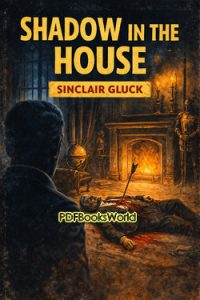
Nick paused on the threshold of the open door and studied with searching scrutiny the tragic scene that met his gaze.
 Library