The North Shore Mystery
The Story of Greece: Told to Boys and Girls
The Lady from Long Acre
The Monk: A Romance
The Adventures of Gil Blas of Santillane, Volume 1 (of 3)
Motor Matt's Submarine
Scottish Honor, Military Adventure, and Political Intrigue in Seventeenth-Century Europe
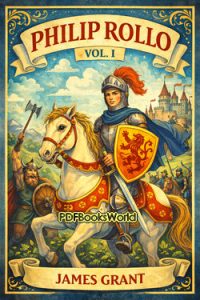
Philip Rollo, Vol. I (of 2)byJames Grant, also known asPhilip Rollo; Or, the Scottish Musketeers, is a historical adventure novel blending warfare, romance, political conflict, and heroic military action within the turbulent world of seventeenth-century Europe. First published in 1854, the novel reflects Grant’s fascination with Scottish military history and the adventurous traditions of historical romance fiction.
Grant presents the Scottish musketeers as courageous soldiers navigating dangerous political struggles, battlefield conflicts, and personal rivalries while preserving loyalty, honor, and national pride amid unstable times.
The Adventures of Philip Rollo
The story follows Philip Rollo, a young Scottish gentleman whose life becomes entangled with military service, political conspiracies, and dangerous journeys across Europe. Through battles, duels, shifting alliances, and dramatic encounters, Philip enters a world shaped by royal conflict, personal ambition, and martial loyalty.
The novel draws heavily upon the romantic traditions of swashbuckling historical fiction, combining swordplay, heroic courage, suspenseful escapes, and emotional drama within richly described historical settings.
Rather than presenting warfare solely as political history, the work emphasizes personal bravery, friendship, loyalty, and the adventurous lives of soldiers serving abroad.
The volume reflects nineteenth-century fascination with Scottish identity, military tradition, and the heroic myths associated with Europe’s earlier conflicts.
Its tone combines energetic action with romantic idealism and historical atmosphere.
The Scottish Musketeers and Martial Brotherhood
A major theme throughout the novel is the importance of loyalty among soldiers facing danger, betrayal, and political uncertainty.
Grant repeatedly explores military honor, courage under pressure, and the emotional bonds formed through shared hardship and battlefield experience.
The work also reflects admiration for Scottish regiments and expatriate soldiers who fought across continental Europe during periods of dynastic and religious conflict.
This martial spirit gives the novel much of its dramatic energy and patriotic character.
Historical and Adventure Themes Explored Throughout the Novel
Scottish Military Tradition: The novel celebrates courage, discipline, and loyalty among Scottish soldiers.Political Intrigue and Conflict: Characters navigate conspiracies, shifting alliances, and dangerous power struggles.Adventure and Heroic Action: Duels, battles, escapes, and dramatic encounters shape the narrative.Honor, Friendship, and Loyalty: Personal relationships remain central amid violence and uncertainty.Historical Romance and Swashbuckling Drama: The story blends military history with emotional and adventurous storytelling.
The novel stands as a representative example of Victorian historical adventure fiction inspired by Scottish history and European warfare.
The Romance of Warfare and Heroism
One of the work’s strongest ideas is that courage and personal honor remain essential virtues even during periods of political chaos and violent conflict.
Grant repeatedly demonstrates how individuals preserve dignity and loyalty while facing betrayal, danger, and shifting historical circumstances.
The novel also reveals nineteenth-century fascination with heroic military identity and the romanticization of earlier European conflicts.
This mixture of historical atmosphere and adventurous storytelling gives the narrative lasting entertainment value.
James Grant’s Energetic Historical Style
Philip Rollodemonstrates James Grant’s ability to combine military history, dramatic action, romantic intrigue, and vivid historical description into engaging adventure fiction.
The writing remains fast-moving, colorful, and strongly focused upon maintaining suspense, emotional intensity, and heroic momentum throughout the story.
Grant consistently presents history as a living world filled with danger, ambition, and larger-than-life personalities.
Why the Novel Still Holds Historical and Literary Interest
Modern readers continue findingPhilip Rolloentertaining because it captures the excitement and romantic energy of Victorian historical adventure fiction inspired by European warfare and Scottish tradition.
The novel also provides insight into nineteenth-century literary fascination with martial heroism, nationalism, and swashbuckling historical romance.
Its themes of loyalty, courage, political intrigue, and military brotherhood continue appealing to readers who enjoy historical adventures and classic romantic fiction.
For readers interested in Scottish history, military fiction, historical romance, swashbuckling adventures, Victorian literature, European warfare, and classic historical novels, this work remains adventurous, dramatic, and historically atmospheric.
PHILIP ROLLO;
OR,
THE SCOTTISH MUSKETEERS.
BY
JAMES GRANT,
AUTHOR OF "ROMANCE OF WAR," "JANE SETON," &c. &c.
"'Tis a tale of campaigning, of love, and invading,
Of marches, of routes, bivouacs, enfilading;
Of batteries and breaches, howitzers and mortars,
Of posts and intrenchments; of in and out quarters;
Of advancing in line, by columns, divisions,
And fighting whole days without rum or provisions."
IN TWO VOLUMES,
VOL. I.
LONDON:
GEORGE ROUTLEDGE & CO., FARRINGDON STREET.
1854.
M'CORQUODALE AND CO., PRINTERS, LONDON.—WORKS, NEWTON.
INTRODUCTION.
At a sale of the effects of an eminent antiquary lately deceased, it was our happiness and good fortune to become the possessor of a certain little MS. volume, closely written, in a neat small hand of the 17th century. It is very thick, contains nearly a thousand pages, is bound in black leather, and is fastened by two brass clasps. On the title-page was written, "The Storie of my Lyffe, concludit to this year 1660."
On examining our literary and antiquarian treasure, which we did with ardour, we found that it was the adventures of a Scottish gentleman, of that stirring period indicated by the date, who had served for a time, as a soldier of fortune, in the armies of Denmark. We found the book interesting, from the glimpses of wild adventure, hair-breadth escapes, high military courage, and raciness it exhibited; thus, the more we read, the more pleased did we become.
Philip Rollo, for such was the name of the writer, seemed to be beside us relating his own startling adventures; and we were upon the point of handing over the MS. to our enterprising friends of the Bannatyne Club, when, lo! we discovered that there were two serious gaps in it. Though having little doubt that the archaeologists would gladly publish these curious memoirs even in their mutilated state, we preferred to restore the thread of the narrative, so far as we could do so, from the quaint pages of the
Amsterdam Courant
, the
Swedish Intelligencer
, the warlike story of Colonel Monro and others, and, after modernising the spelling and language of the whole, so as to make it more generally readable, handed over our transcript to our friend Mr. Routledge, of London.
Those portions of the work which have been made up from contemporary authority, we are much too cunning to point out; though we have little doubt that the critical reader will easily recognise them. But we may add that, historically considered, we have found the military details to tally so closely with those given in the Low Dutch "Relation," "Ye Danish Warres," and other works, that our soldier of fortune may defy the closest scrutiny.
When we read the memoirs of any eminent man of whom no portrait is extant, we are naturally curious to know what like he was—the colour of his eyes, of his hair, and so forth; and, most fortunately, before entering upon the adventures of Philip Rollo, we are enabled to afford the reader a pretty good idea of these matters; for at the same extensive sale, where it was our fortune to find the MS., a portrait of the cavalier was "knocked down" to us for a comparative trifle—nothing, absolutely, when we consider that it was a real and well-authenticated
Jamesone
, an artist, so justly esteemed the Vandyke of Scotland, and who studied with Sir Anthony under Rubens at Antwerp.
This portrait, which appears, by a date inscribed thereon, to have been painted about the year 1630, exhibits an eminently handsome cavalier in the gallant and picturesque costume of that time. The face is oval—the forehead white and high—the mustaches and imperial well pointed—the eyes are dark—the hair long and of the deepest brown. The left hand rests in the bowl hilt of a long Spanish rapier, which hangs in a magnificent baldric, worn sash-wise over the right shoulder; the right hand rests on a helmet, to show that it is the portrait of a gentleman and soldier. We have also an admirable example of the Scottish costume of the period. This cavalier's doublet having loose sleeves, slashed with white, the collar being covered by a falling band of the richest point lace; a short crimson cloak hangs jauntily on the left shoulder; the breeches are of blue velvet, fringed with point lace, and meet the long riding boots, which have tops of ruffled lace. A military order sparkles on his breast, and a dagger dangles at his right side. Under the helmet there peeps out a slip of paper, on which is written,
Philip Rollo, hys portraitoure
.
There is a proud and lofty expression in the face of this old portrait (which is now hanging above my writing-table), that is remarkably pleasing and impressive. While gazing at it, the dark eyes seem to fill with dusky fire—the proud lips to curl, and the manly breast to expand with the high military spirit the original once possessed, while the clouds of battle, which envelope the background, seem once more to roll around him on the wind. This is power of the Jamesone's pencil—that magic power which the lapse of more than two hundred years has failed to obliterate; and we hope that the reader will, erelong, be as interested as we are ourselves in the fortunes and misfortunes, loves and adventures, of Philip Rollo, whose personal memoirs appear to have been compiled by himself for his own amusement, rather than for that of others.
Book the First.
PHILIP ROLLO; OR, THE SCOTTISH MUSKETEERS. BY JAMES GRANT, AUTHOR OF "ROMANCE OF WAR," "JANE SETON," &c. &c. "'Tis a tale of campaigning, of love, and invadin…
OF MY FAMILY, AND THE MISFORTUNE OF NOT HAVING A LARGE MOUTH. I was born in the year after King James VI. acquired the dominion of England, at my father's tower of Craigrollo, which overlooks th…
HOW I BECAME A SOLDIER OF FORTUNE. Having completed my studies at the King's College, I left it in the June of 1626, and returned to my father's house, from which I had been so long absent,…
SIR DONALD AND HIS REGIMENT. From an eminent armourer in the Castlegate of the Brave Town of Aberdeen, I had purchased a suit of plain but well-tempered armour, such as a gentleman might wear, and su…
WE SAIL FOR THE ELBE. The culverins of the Unicorn and Crown Royal fired a salute to the chief of Strathnaver as we embarked, on the first day of October, though contrary winds delayed us till the …
GLUCKSTADT. His Danish majesty, the gallant King Christian IV., whom we were about to reinforce, was at this time waging with the vast forces of the empire, an unequal warfare in the same cause which…
AFTER ESCAPING A FALL INTO THE ELBE, I AM IN DANGER OF FALLING IN LOVE. Though the majority of the inhabitants of Glückstadt had retired to adjacent villages or elsewhere, on the town being occupied …
THE REPAST. "Welcome, Philip, as we are here before you," said Ian; "in the name of mischief's mother, where have you been wandering to?" "Over all this empty house, wh…
OUR CANTONMENT. The next day's sun rose bright and radiant; the birds sang in the green poplars; the storks screamed on the red gable-tops; the great frogs were croaking hoarsely among the bronz…
THE MYSTERIOUS DOOR;—A DISCOURSE ON NYMPHS. On the 6th day after our landing, Ian and his sergeant, Phadrig Mhor, with sixty of our pikemen, were on guard in the great tower at the harbour mouth. Aft…

A Fast-Paced Tale of Boxing, Adventure, and Regency England Rodney StonebyArthu…
Read more

A Dark and Suspenseful Novel About Espionage, Politics, and Human Manipulation …
Read more

A Quiet Community Hides a Dangerous Secret The North Shore MysterybyHenry Fletc…
Read more