Don't Panic!
The Red Badge of Courage - An Episode of the American Civil War
Stories of the Days of King Arthur
The Hero of the People - A Historical Romance of Love, Liberty and Loyalty
Under Three Flags
A United States Midshipman in China
Love, Politics, and Memory in Conrad’s Reflective Romance
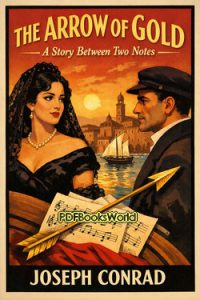
The Arrow of Gold: A Story Between Two NotesbyJoseph Conradis a richly atmospheric novel blending political intrigue, emotional longing, memory, and romantic obsession. Set against the backdrop of late nineteenth-century revolutionary activity in Europe, the novel moves between danger and introspection, combining espionage with deeply personal emotional conflict.
Unlike Conrad’s harsher sea novels, this work carries a more reflective and melancholic tone. The story unfolds as a memory shaped by desire, regret, and the emotional intensity of youth.
A Young Man Drawn Into a Dangerous World
The narrator, recalling events from his younger years, becomes connected to a secretive circle supporting the Carlist political movement in Spain. While involved in transporting weapons and participating in risky political operations, he encounters Dona Rita, a mysterious and captivating woman whose emotional presence transforms his life.
Dona Rita exists at the center of competing political loyalties, romantic tensions, and dangerous personal relationships.
The narrator’s fascination with her gradually deepens into emotional obsession, forcing him to navigate jealousy, uncertainty, and the emotional instability surrounding revolutionary politics.
Conrad presents both love and political idealism as forces capable of inspiring devotion while also leading toward suffering and confusion.
The People Caught Between Passion and Politics
The NarratorA reflective young man whose emotional and political experiences shape his understanding of life.Dona RitaAn intelligent and emotionally complex woman surrounded by admiration, mystery, and conflict.GeorgeA passionate revolutionary deeply connected to both politics and personal rivalry.The Revolutionary CircleFigures involved in political struggle, secrecy, and dangerous idealism.
The emotional relationships between these characters create tension that feels as important as the external political events.
A Novel Filled With Atmosphere and Reflection
Conrad writes the novel with unusual warmth and emotional nostalgia compared to some of his darker works. The narrative often feels dreamlike, moving through memory, conversation, emotional impression, and symbolic imagery.
Political conspiracies and revolutionary plans remain important, yet the deeper focus stays personal and emotional. The story becomes an examination of youth, desire, illusion, and emotional awakening.
The Mediterranean settings, moonlit scenes, hidden meetings, and quiet moments of reflection give the novel a romantic and melancholic atmosphere.
Central Themes Within the Novel
Love and Emotional ObsessionThe narrator’s relationship with Dona Rita becomes emotionally consuming and transformative.Political Idealism and DisillusionmentRevolutionary causes appear both noble and emotionally destructive.Memory and NostalgiaThe novel reflects on youth through the softened but painful perspective of later recollection.Jealousy and RivalryPersonal relationships become entangled with political loyalties and emotional insecurity.
A More Romantic Side of Joseph Conrad
The Arrow of Goldreveals a different emotional register within Conrad’s fiction. While still psychologically complex and morally ambiguous, the novel carries greater tenderness and introspection than many of his more severe political works.
Conrad focuses heavily on emotional atmosphere, creating scenes filled with longing, uncertainty, and remembered beauty. The title itself suggests something precious, fleeting, and impossible to fully possess.
The novel feels deeply shaped by memory and emotional reflection rather than direct action alone.
Why Readers Continue Returning to It
Modern readers continue appreciatingThe Arrow of Goldbecause it captures the emotional intensity of youth, desire, and political idealism with unusual sensitivity.
The novel also feels modern in its understanding of memory’s instability. The narrator does not present the past with perfect clarity, but as something emotionally reconstructed through longing and reflection.
For readers interested in literary romance, political fiction, and psychologically nuanced storytelling, this novel remains atmospheric, elegant, and emotionally resonant.
SECOND NOTE
THE
ARROW OF GOLD
A STORY BETWEEN TWO NOTES
by
JOSEPH CONRAD
Celui qui n’a connu que des hommes
polis et raisonnables, ou ne connait pas
l’homme, ou ne le connait qu’a demi.
Caracteres
.
T. FISHER UNWIN, LTD.
LONDON: ADELPHI TERRACE
all rights reserved
to
RICHARD CURLE
FIRST NOTE
The pages which follow have been extracted from a pile of manuscript which was apparently meant for the eye of one woman only. She seems to have been the writer’s childhood’s friend. They had parted as children, or very little more than children. Years passed. Then something recalled to the woman the companion of her young days and she wrote to him: “I have been hearing of you lately. I know where life has brought you. You certainly selected your own road. But to us, left behind, it always looked as if you had struck out into a pathless desert. We always regarded you as a person that must be given up for lost. But you have turned up again; and though we may never see each other, my memory welcomes you and I confess to you I should like to know the incidents on the road which has led you to where you are now.”
And he answers her: “I believe you are the only one now alive who remembers me as a child. I have heard of you from time to time, but I wonder what sort of person you are now. Perhaps if I did know I wouldn’t dare put pen to paper. But I don’t know. I only remember that we were great chums. In fact, I chummed with you even more than with your brothers. But I am like the pigeon that went away in the fable of the Two Pigeons. If I once start to tell you I would want you to feel that you have been there yourself. I may overtax your patience with the story of my life so different from yours, not only in all the facts but altogether in spirit. You may not understand. You may even be shocked. I say all this to myself; but I know I shall succumb! I have a distinct recollection that in the old days, when you were about fifteen, you always could make me do whatever you liked.”
He succumbed. He begins his story for her with the minute narration of this adventure which took about twelve months to develop. In the form in which it is presented here it has been pruned of all allusions to their common past, of all asides, disquisitions, and explanations addressed directly to the friend of his childhood. And even as it is the whole thing is of considerable length. It seems that he had not only a memory but that he also knew how to remember. But as to that opinions may differ.
This, his first great adventure, as he calls it, begins in Marseilles. It ends there, too. Yet it might have happened anywhere. This does not mean that the people concerned could have come together in pure space. The locality had a definite importance. As to the time, it is easily fixed by the events at about the middle years of the seventies, when Don Carlos de Bourbon, encouraged by the general reaction of all Europe against the excesses of communistic Republicanism, made his attempt for the throne of Spain, arms in hand, amongst the hills and gorges of Guipuzcoa. It is perhaps the last instance of a Pretender’s adventure for a Crown that History will have to record with the usual grave moral disapproval tinged by a shamefaced regret for the departing romance. Historians are very much like other people.
However, History has nothing to do with this tale. Neither is the moral justification or condemnation of conduct aimed at here. If anything it is perhaps a little sympathy that the writer expects for his buried youth, as he lives it over again at the end of his insignificant course on this earth. Strange person—yet perhaps not so very different from ourselves.
A few words as to certain facts may be added.
It may seem that he was plunged very abruptly into this long adventure. But from certain passages (suppressed here because mixed up with irrelevant matter) it appears clearly that at the time of the meeting in the café, Mills had already gathered, in various quarters, a definite view of the eager youth who had been introduced to him in that ultra-legitimist salon. What Mills had learned represented him as a young gentleman who had arrived furnished with proper credentials and who apparently was doing his best to waste his life in an eccentric fashion, with a bohemian set (one poet, at least, emerged out of it later) on one side, and on the other making friends with the people of the Old Town, pilots, coasters, sailors, workers of all sorts. He pretended rather absurdly to be a seaman himself and was already credited with an ill-defined and vaguely illegal enterprise in the Gulf of Mexico. At once it occurred to Mills that this eccentric youngster was the very person for what the legitimist sympathizers had very much at heart just then: to organize a supply by sea of arms and ammunition to the Carlist detachments in the South. It was precisely to confer on that matter with Doña Rita that Captain Blunt had been despatched from Headquarters.
Mills got in touch with Blunt at once and put the suggestion before him. The Captain thought this the very thing. As a matter of fact, on that evening of Carnival, those two, Mills and Blunt, had been actually looking everywhere for our man. They had decided that he should be drawn into the affair if it could be done. Blunt naturally wanted to see him first. He must have estimated him a promising person, but, from another point of view, not dangerous. Thus lightly was the notorious (and at the same time mysterious) Monsieur George brought into the world; out of the contact of two minds which did not give a single thought to his flesh and blood.
Their purpose explains the intimate tone given to their first conversation and the sudden introduction of Doña Rita’s history. Mills, of course, wanted to hear all about it. As to Captain Blunt—I suspect that, at the time, he was thinking of nothing else. In addition it was Doña Rita who would have to do the persuading; for, after all, such an enterprise with its ugly and desperate risks was not a trifle to put before a man—however young.
It cannot be denied that Mills seems to have acted somewhat unscrupulously. He himself appears to have had some doubt about it, at a given moment, as they were driving to the Prado. But perhaps Mills, with his penetration, understood very well the nature he was dealing with. He might even have envied it. But it’s not my business to excuse Mills. As to him whom we may regard as Mills’ victim it is obvious that he has never harboured a single reproachful thought. For him Mills is not to be criticized. A remarkable instance of the great power of mere individuality over the young.
PART ONE
SECOND NOTE THE ARROW OF GOLD A STORY BETWEEN TWO NOTES by JOSEPH CONRAD Celui qui n’a connu que des hommes polis et raisonnables, ou ne connait pas l’homme, ou ne le connait qu’a demi. Caracteres . …
Certain streets have an atmosphere of their own, a sort of universal fame and the particular affection of their citizens. One of such streets is the Cannebière, and the jest: “If Paris had a Cannebiè…
The street in which Mr. Blunt lived presented itself to our eyes, narrow, silent, empty, and dark, but with enough gas-lamps in it to disclose its most striking feature: a quantity of flag-poles stick…
Mills lowered the hands holding the extinct and even cold pipe before his big face. “H’m, shoot an arrow into that old man’s heart like this? But was there anything done?” “A terra-cotta bust, I beli…
Sometimes I wonder yet whether Mills wished me to oversleep myself or not: that is, whether he really took sufficient interest to care. His uniform kindliness of manner made it impossible for me to t…
For this, properly speaking wonderful, reason I was the only one of the company who could listen without constraint to the unbidden guest with that fine head of white hair, so beautifully kept, so mag…
Mills got up and approached the figure at the window. To my extreme surprise, Mr. Blunt, after a moment of obviously painful hesitation, hastened out after the man with the white hair. In consequence…
It was past four o’clock before I left the house, together with Mills. Mr. Blunt, still in his riding costume, escorted us to the very door. He asked us to send him the first fiacre we met on our wa…
It was on our return from that first trip that I took Dominic up to the Villa to be presented to Doña Rita. If she wanted to look on the embodiment of fidelity, resource, and courage, she could behol…
Doña Rita was curious to know how I got on with her peasant sister and all I could say in return for that inquiry was that the peasant sister was in her own way amiable. At this she clicked her tongu…

A Frontier Mystery of Deception, Danger, and Adventure The Strange DecoybyJos. …
Read more

A Landmark of American LiteratureAdventures of Huckleberry Finnis one of the mo…
Read more

A Quiet Community Hides a Dangerous Secret The North Shore MysterybyHenry Fletc…
Read more