A West Point Treasure
Captain Ravenshaw or The Maid of Cheapside - A Romance of Elizabethan London
The Mysterious Affair at Styles
The Refugees
A Daughter of Witches - A Romance
A United States Midshipman in the Philippines
A Brilliant Philosophical Thriller Blending Mystery, Symbolism, and Surreal Adventure
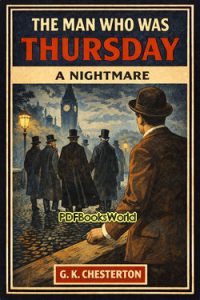
The Man Who Was Thursday - A NightmarebyG. K. Chestertonis one of the most unusual and imaginative novels of the early twentieth century. Combining detective fiction, political satire, philosophical reflection, surreal fantasy, and psychological mystery, the novel creates a dreamlike adventure filled with secret societies, disguises, danger, and symbolic meaning.
Although the story begins like a suspenseful spy thriller involving anarchists and undercover detectives, it gradually transforms into a deeper exploration of identity, order, fear, chaos, and the mysteries of human existence.
The Strange and Unforgettable Story
The novel follows Gabriel Syme, a poet recruited into a secret anti-anarchist police organization. Through a bizarre series of events, Syme infiltrates a mysterious anarchist council whose members are named after days of the week.
Syme himself becomes “Thursday,” while attempting to uncover the terrifying secrets surrounding the council and its enigmatic leader, Sunday.
As the story progresses, reality becomes increasingly strange and uncertain. What begins as political intrigue develops into a surreal nightmare filled with pursuit, disguise, philosophical confusion, and symbolic encounters.
Main Characters in the Novel
The novel's memorable characters contribute greatly to its atmosphere of mystery and uncertainty.
Gabriel Syme, the poet-detective searching for truth and orderSunday, the mysterious and powerful leader of the anarchist councilThe council members, each named after a day of the weekUndercover detectives and hidden identitiescomplicating the narrative
The characters often represent larger philosophical ideas as much as individual personalities.
Main Themes Explored Throughout the Novel
The Man Who Was Thursdayexplores several themes that continue to fascinate readers and scholars.
The conflict between order and chaosIdentity, disguise, and hidden truthFear, uncertainty, and psychological confusionThe relationship between good and evilPhilosophical and spiritual mysteryThe surreal nature of human experience
These themes help make the novel both intellectually challenging and emotionally compelling.
Why Readers Continue to Admire the Novel
Readers continue to appreciate the novel because it defies easy classification. It combines suspense, humor, philosophy, symbolism, and dreamlike imagination in a way that feels highly original even today.
The novel offers:
A fast-moving and unpredictable mystery narrativePhilosophical reflection beneath the surface adventureSymbolic and surreal storytellingSharp wit and imaginative literary style
The story rewards both casual readers seeking suspense and deeper readers interested in symbolism and philosophy.
The Writing Style of G. K. Chesterton
G. K. Chesterton writes with intelligence, humor, paradox, and extraordinary imagination. His prose moves quickly between comedy, suspense, philosophical reflection, and surreal imagery.
The novel's dreamlike atmosphere allows ordinary reality to become strange and symbolic, creating a unique reading experience that feels both entertaining and deeply mysterious.
Chesterton's ability to combine intellectual ideas with dramatic storytelling helped make the novel a lasting literary classic.
A Timeless Masterpiece of Mystery, Philosophy, and Imagination
Classic literary thrillers continue to remain meaningful because they explore fear, identity, morality, and human uncertainty through imaginative storytelling and symbolic depth.
The Man Who Was Thursday - A NightmarebyG. K. Chestertonremains a remarkable and unforgettable novel that combines mystery, satire, philosophy, and surreal adventure into one of the most original works in modern literature.
THE MAN WHO WAS THURSDAY
A NIGHTMARE
by G. K. Chesterton
A WILD, MAD, HILARIOUS AND PROFOUNDLY MOVING TALE
It is very difficult to classify THE MAN WHO WAS THURSDAY. It is possible to say that it is a gripping adventure story of murderous criminals and brilliant policemen; but it was to be expected that the author of the Father Brown stories should tell a detective story like no-one else. On this level, therefore, THE MAN WHO WAS THURSDAY succeeds superbly; if nothing else, it is a magnificent tour-de-force of suspense-writing.
However, the reader will soon discover that it is much more than that. Carried along on the boisterous rush of the narrative by Chesterton’s wonderful high-spirited style, he will soon see that he is being carried into much deeper waters than he had planned on; and the totally unforeseeable denouement will prove for the modern reader, as it has for thousands of others since 1908 when the book was first published, an inevitable and moving experience, as the investigators finally discover who Sunday is.
THE MAN WHO WAS THURSDAY
A NIGHTMARE
To Edmund Clerihew Bentley
A cloud was on the mind of men, and wailing went the weather,
Yea, a sick cloud upon the soul when we were boys together.
Science announced nonentity and art admired decay
;
The world was old and ended: but you and I were gay;
Round us in antic order their crippled vices came—
Lust that had lost its laughter, fear that had lost its shame.
Like the white lock of Whistler, that lit our aimless gloom,
Men showed their
own white feather as proudly as a plume.
Life was a fly that faded, and death a drone that stung;
The world was very old indeed when you and I were young.
They twisted even decent sin to shapes not to be named:
Men were ashamed of honour; but we were not ashamed.
Weak if we were and foolish, not thus we failed, not thus;
When that black Baal blocked the heavens he had no hymns from us
Children we were—our forts of sand were even as weak as we,
High as the
y went we piled them up to break that bitter sea.
Fools as we were in motley, all jangling and absurd,
When all church bells were silent our cap and bells were heard.
Not all unhelped we held the fort, our tiny flags unfurled;
Some giants laboured
in that cloud to lift it from the world.
I find again the book we found, I feel the hour that flings
Far out of fish-shaped Paumanok some cry of cleaner things;
And the Green Carnation withered, as in forest fires that pass,
Roared in the wind of
all the world ten million leaves of grass;
Or sane and sweet and sudden as a bird sings in the rain—
Truth out of Tusitala spoke and pleasure out of pain.
Yea, cool and clear and sudden as a bird sings in the grey,
Dunedin to Samoa spoke, and darkn
ess unto day.
But we were young; we lived to see God break their bitter charms.
God and the good Republic come riding back in arms:
We have seen the City of Mansoul, even as it rocked, relieved—
Blessed are they who did not see, but being blind, be
lieved.
This is a tale of those old fears, even of those emptied hells,
And none but you shall understand the true thing that it tells—
Of what colossal gods of shame could cow men and yet crash,
Of what huge devils hid the stars, yet fell at a pi
stol flash.
The doubts that were so plain to chase, so dreadful to withstand—
Oh, who shall understand but you; yea, who shall understand?
The doubts that drove us through the night as we two talked amain,
And day had broken on the streets e’er it broke upon the brain.
Between us, by the peace of God, such truth can now be told;
Yea, there is strength in striking root and good in growing old.
We have found common things at last and marriage and a creed
,
And I may safely write it now, and you may safely read.
G. K. C.
THE MAN WHO WAS THURSDAY A NIGHTMARE by G. K. Chesterton A WILD, MAD, HILARIOUS AND PROFOUNDLY MOVING TALE It is very difficult to classify THE MAN WHO WAS THURSDAY. It is possible to say that …
THE suburb of Saffron Park lay on the sunset side of London, as red and ragged as a cloud of sunset. It was built of a bright brick throughout; its sky-line was fantastic, and even its ground plan was…
THE cab pulled up before a particularly dreary and greasy beershop, into which Gregory rapidly conducted his companion. They seated themselves in a close and dim sort of bar-parlour, at a stained wood…

BEFORE one of the fresh faces could appear at the doorway, Gregory’s stunned surprise had fallen from him. He was beside the table with a bound, and a noise in his throat like a wild beast. He caught …
GABRIEL SYME was not merely a detective who pretended to be a poet; he was really a poet who had become a detective. Nor was his hatred of anarchy hypocritical. He was one of those who are driven earl…
AT first the large stone stair seemed to Syme as deserted as a pyramid; but before he reached the top he had realised that there was a man leaning over the parapet of the Embankment and looking out ac…
SUCH were the six men who had sworn to destroy the world. Again and again Syme strove to pull together his common sense in their presence. Sometimes he saw for an instant that these notions were subje…
“SIT down!” said Sunday in a voice that he used once or twice in his life, a voice that made men drop drawn swords. The three who had risen fell away from Gogol, and that equivocal person himself res…
WHEN Gabriel Syme found himself finally established in a chair, and opposite to him, fixed and final also, the lifted eyebrows and leaden eyelids of the Professor, his fears fully returned. This incom…
“BURGUNDY is a jolly thing,” said the Professor sadly, as he set his glass down. “You don’t look as if it were,” said Syme; “you drink it as if it were medicine.” “You must excuse my manner,” said t…

WhyKing Solomon's MinesRemains a Classic Adventure Masterpiece King Solomon's M…
Read more

The Hound of the Baskervilles: Sherlock Holmes Faces His Most Haunting MysteryT…
Read more

A Quiet Community Hides a Dangerous Secret The North Shore MysterybyHenry Fletc…
Read more