Special Detective (Ashton-Kirk)
Topsy-Turvy or The Purchase of the North Pole
Colville of the Guards, Volume 1 (of 3)
The Crime Club
The Prussian Terror
A United States Midshipman in China
War, Loyalty, and the Tragic Fate of a Powerful Outsider
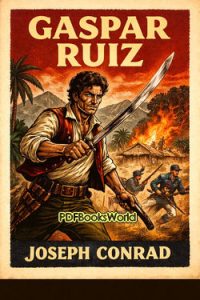
Gaspar RuizbyJoseph Conradis a dramatic historical tale set during the violent wars of independence in South America. Combining political conflict with psychological depth, the story follows a physically powerful but emotionally simple man whose life becomes shaped by war, shifting loyalties, and forces far beyond his understanding.
Though shorter than many of Conrad’s major works, the story carries intense emotional and moral weight. Conrad transforms military struggle into a meditation on fate, identity, and human vulnerability within chaotic historical change.
A Giant Caught Between Opposing Armies
Gaspar Ruiz is introduced as a strong and quiet rural laborer living in a land torn apart by revolution and civil conflict. Because of his enormous physical strength, he becomes valuable to competing military factions fighting for control.
Yet Gaspar himself remains largely indifferent to political ideology.
He is repeatedly captured, forced into service, punished, and manipulated by larger political forces that view him more as a tool than as an individual.
As war continues reshaping the country around him, Gaspar struggles to preserve loyalty, affection, and personal dignity within a brutal and unstable world.
The Figures Surrounding Gaspar’s Tragic Journey
Gaspar RuizA physically powerful but emotionally straightforward man trapped within violent political conflict.Military Leaders and RevolutionariesFigures driven by ambition, ideology, and the shifting demands of war.The Woman Connected to Gaspar’s Personal LifeA source of emotional attachment and fragile human connection amid violence.
Conrad presents these relationships with sympathy while emphasizing the destructive unpredictability of war.
History as a Force Beyond Individual Control
One of the story’s most striking qualities is its portrayal of historical conflict as something overwhelming and impersonal. Gaspar is neither a grand hero nor a committed revolutionary. Instead, he becomes swept along by events he cannot fully influence or understand.
Conrad suggests that ordinary individuals often suffer most deeply during periods of political upheaval because they possess little control over the violent systems surrounding them.
The emotional tragedy emerges from this imbalance between personal humanity and historical chaos.
Major Themes Within the Story
War and Human SufferingPolitical conflict destroys stability and reduces individuals to instruments of violence.Loyalty and BetrayalCharacters struggle to maintain personal loyalty within unstable political circumstances.Fate and PowerlessnessGaspar’s life becomes shaped by forces larger than his own desires or intentions.Strength and VulnerabilityDespite his physical power, Gaspar remains emotionally and socially fragile.
Conrad’s Historical and Psychological Vision
Gaspar Ruizdemonstrates Conrad’s ability to combine historical conflict with intimate psychological observation. The story contains battles, military tension, and dramatic reversals, yet its emotional core remains deeply personal.
Conrad avoids romanticizing revolution or warfare. Instead, he portrays political violence as chaotic, morally uncertain, and emotionally destructive.
The atmosphere remains tense and melancholic throughout, shaped by fatalism and emotional loss.
Why the Story Still Feels Powerful Today
Modern readers continue findingGaspar Ruizcompelling because its themes remain deeply relevant. Political instability, civil conflict, manipulation by powerful institutions, and the suffering of ordinary people continue shaping history around the world.
The story also feels modern in its psychological realism. Conrad understands how individuals can become trapped within systems and events they never truly chose.
For readers interested in historical fiction, political storytelling, and psychologically complex literary classics, this tale remains moving, intense, and unforgettable.
A Revolutionary war raises many strange characters out of the obscurity which is the common lot of humble lives in an undisturbed state of society.
Certain individualities grow into fame through their vices and their virtues, or simply by their actions, which may have a temporary importance; and then they become forgotten. The names of a few leaders alone survive the end of armed strife and are further preserved in history; so that, vanishing from men’s active memories, they still exist in books.
The name of General Santierra attained that cold, paper-and-ink immortality. He was a South American of good family, and the books published in his lifetime numbered him amongst the liberators of that continent from the oppressive rule of Spain.
That long contest, waged for independence on one side and for dominion on the other, developed, in the course of years and the vicissitudes of changing fortune, the fierceness and inhumanity of a struggle for life. All feelings of pity and compassion disappeared in the growth of political hatred. And, as is usual in war, the mass of the people, who had the least to gain by the issue, suffered most in their obscure persons and their humble fortunes.
General Santierra began his service as lieutenant in the patriot army raised and commanded by the famous San Martin, afterwards conqueror of Lima and liberator of Peru. A great battle had just been fought on the banks of the river Bio-Bio. Amongst the prisoners made upon the routed Royalist troops there was a soldier called Gaspar Ruiz. His powerful build and his big head rendered him remarkable amongst his fellow-captives. The personality of the man was unmistakable. Some months before, he had been missed from the ranks of Republican troops after one of the many skirmishes which preceded the great battle. And now, having been captured arms in hand amongst Royalists, he could expect no other fate but to be shot as a deserter.
Gaspar Ruiz, however, was not a deserter; his mind was hardly active enough to take a discriminating view of the advantages or perils of treachery. Why should he change sides? He had really been made a prisoner, had suffered ill-usage and many privations. Neither side showed tenderness to its adversaries. There came a day when he was ordered, together with some other captured rebels, to march in the front rank of the Royal troops. A musket, had been thrust into his hands. He had taken it. He had marched. He did not want to be killed with circumstances of peculiar atrocity for refusing to march. He did not understand heroism, but it was his intention to throw his musket away at the first opportunity. Meantime he had gone on loading and firing, from fear of having his brains blown out, at the first sign of unwillingness, by some non-commissioned officer of the King of Spain. He tried to set forth these elementary considerations before the sergeant of the guard set over him and some twenty other such deserters, who had been condemned summarily to be shot.
It was in the quadrangle of the fort at the back of the batteries which command the road-stead of Valparaiso. The officer who had identified him had gone on without listening to his protestations. His doom was sealed; his hands were tied very tightly together behind his back; his body was sore all over from the many blows with sticks and butts of muskets which had hurried him along on the painful road from the place of his capture to the gate of the fort. This was the only kind of systematic attention the prisoners had received from their escort during a four days’ journey across a scantily watered tract of country. At the crossings of rare streams they were permitted to quench their thirst by lapping hurriedly like dogs. In the evening a few scraps of meat were thrown amongst them as they dropped down dead-beat upon the stony ground of the halting-place.
As he stood in the courtyard of the castle in the early morning, after having been driven hard all night, Gaspar Ruiz’s throat was parched, and his tongue felt very large and dry in his mouth.
And Gaspar Ruiz, besides being very thirsty, was stirred by a feeling of sluggish anger, which he could not very well express, as though the vigour of his spirit were by no means equal to the strength of his body.
The other prisoners in the batch of the condemned hung their heads, looking obstinately on the ground. But Gaspar Ruiz kept on repeating: “What should I desert for to the Royalists? Why should I desert? Tell me, Estaban!”
He addressed himself to the sergeant, who happened to belong to the same part of the country as himself. But the sergeant, after shrugging his meagre shoulders once, paid no further attention to the deep murmuring voice at his back. It was indeed strange that Gaspar Ruiz should desert. His people were in too humble a station to feel much the disadvantages of any form of government. There was no reason why Gaspar Ruiz should wish to uphold in his own person the rule of the King of Spain. Neither had he been anxious to exert himself for its subversion. He had joined the side of Independence in an extremely reasonable and natural manner. A band of patriots appeared one morning early, surrounding his father’s ranche, spearing the watch-dogs and hamstringing a fat cow all in the twinkling of an eye, to the cries of “Viva La Libertad!” Their officer discoursed of Liberty with enthusiasm and eloquence after a long and refreshing sleep. When they left in the evening, taking with them some of Ruiz, the father’s, best horses to replace their own lamed animals, Gaspar Ruiz went away with them, having been invited pressingly to do so by the eloquent officer.
Shortly afterwards a detachment of Royalist troops, coming to pacify the district, burnt the ranche, carried off the remaining horses and cattle, and having thus deprived the old people of all their worldly possessions, left them sitting under a bush in the enjoyment of the inestimable boon of life.
A Revolutionary war raises many strange characters out of the obscurity which is the common lot of humble lives in an undisturbed state of society. Certain individualities grow into fame through thei…

GASPAR Ruiz, condemned to death as a deserter, was not thinking either of his native place or of his parents, to whom he had been a good son on account of the mildness of his character and the great s…
“YES, my friends,” he used to say to his guests, “what would you have? A youth of seventeen summers, without worldly experience, and owing my rank only to the glorious patriotism of my father, may God…
“GASPAR RUIZ had clambered up on the sill, and sat down there with his feet against the thickness of the wall and his knees slightly bent. The window was not quite broad enough for the length of his l…
GASPAR RUIZ, who could with ease bend apart the heavy iron bars of the prison, was led out with others to summary execution. “Every bullet has its billet,” runs the proverb. All the merit of proverbs …

“I KNEW those people by sight,” General Santierra would tell his guests at the dining-table. “I mean the people with whom Gaspar Ruiz found shelter. The father was an old Spaniard, a man of property, …
GENERAL SANTIERRA was right in his surmise. Such was the exact nature of the assistance which Gaspar Ruiz, peasant son of peasants, received from the Royalist family whose daughter had opened the door…
“SENORES,” related the General to his guests, “though my thoughts were of love then, and therefore enchanting, the sight of that house always affected me disagreeably, especially in the moonlight, whe…
WITH movements of mechanical care and an air of abstraction old General Santierra lighted a long and thick cigar. “It was a good many hours before we could send a party back to the ravine,” he said t…
“AFTER this—as he called it—act of justice, Ruiz crossed the Rio Blanco, followed by the greater part of his band, and entrenched himself upon a hill A company of regular troops sent out foolishly aga…

A Suspenseful Mystery of Manipulation, Secrets, and Hidden Motives The Cat's Pa…
Read more

The Continuing Saga of Duty, Adventure, and Romance The King's Own Borderers: A…
Read more

A Quiet Community Hides a Dangerous Secret The North Shore MysterybyHenry Fletc…
Read more