THE STAR AND THE LILY
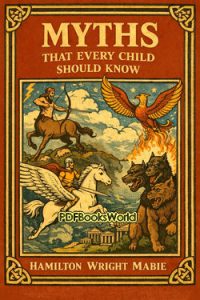
MYTHS THAT EVERY CHILD SHOULD KNOW
A SELECTION OF THE CLASSIC MYTHS OF ALL TIMES FOR YOUNG PEOPLE
EDITED BY
HAMILTON WRIGHT MABIE
ILLUSTRATED AND DECORATED
BY BLANCHE OSTERTAG
NEW YORK
Doubleday, Page & Company
1906
NOTE
The editor and publishers wish to express their appreciation of the courtesy of Messrs. Houghton, Mifflin & Co., Dodd, Mead & Co., and the Macmillan Company, by means of which they have been enabled to reprint stories from Hawthorne's "Wonder Book" and "Tanglewood Tales," from "In the Days of Giants," from "Norse Stories," from Church's "Stories from Homer," and from Kingsley's "Greek Heroes."
INTRODUCTION
In many parts of the country when the soil is disturbed arrow heads are found. Now, it is a great many years since arrow heads have been used, and they were never used by the people who own the land in which they appear or by their ancestors. To explain the presence of these roughly cut pieces of stone we must recall the weapons with which the Indians fought when Englishmen, Frenchmen, Dutchmen, and Spaniards first came to this part of the world. There may be no authentic history of Indians in the particular locality in which these old-fashioned weapons come to light, but their presence in the ground is the best kind of evidence that Indians once lived on these fields or were in the habit of hunting over them. In many parts of the country these arrow heads are turned up in great numbers; museums large and small are plentifully supplied with them; and they form part of the record of the men who once lived here, and of their ways of killing game and destroying their enemies. Wherever there are arrow heads there have been Indians.
Among every people and in every language there are found stories, superstitions, traditions, phrases, which are not to be explained by the thoughts or ideas or beliefs of people now living; and the same stories, superstitions, phrases, are found among people as far apart as those of Norway and Australia. The people of to-day tell these stories or remember the superstitions or use the phrases without understanding where they came from or what
they meant when first used. As the ground in some sections is full of arrow heads that have been buried no one knows how many centuries, so the poetry we read, the music we hear, the stories told us when we are children, have come down from a time in the history of man so early that there are in many cases no other records or remains of it. These stories vary greatly in details; they fit every climate and wear the peculiar dress of every country; but it is easy to see that they are made up of the same materials, and that they describe the same persons or ideas or things whether they are told in Greece or India or Norway or Brittany. Wherever they are found they make it certain that they come from a very remote time and grew out of ideas or feelings and ways of looking at the world which a great many men shared in common in many places.
When a man sneezes, people still say in some countries, "God bless you." They do not know why they say it; they simply repeat what they heard older people say when they were children, and do not know that every time they use these words they recall the age when people believed that evil spirits could enter into a man, and that when a man sneezed he expelled one of these spirits. It is a very old and widely spread superstition that when a dog howls at night someone not far away is dying or will soon die. Many people are uncomfortable when they hear a dog howling after dark, not because they believe that dogs have any knowledge that death is present or coming, but because their ancestors for many centuries believed that the howling of a dog was ominous, and the habits of our ancestors leave deep traces in our natures.
Now, every time the melancholy howling of a dog at night makes a child uncomfortable, he recalls the old superstition which identified the roaring or wailing of the
wind with a wolf or dog into which a god or demon had entered, with power to summon the spirits of men to follow him as he rushed along in the darkness. In the old homes in the forests, thousands of years ago, children crowded about the open fire and trembled when a great blast shook the house, for fear that the gigantic beast who made the sound would call them and they would be compelled to follow him. We think of wind as air in motion; they thought of it as the breath and sound of some living creature. When we say that the wind "whistled in the keyhole," or "kissed the flowers," or "drove the clouds" before it, we are using poetically the language our forefathers used literally.
We speak of "the siren voice of pleasure," "the blow of fate," "the smile of fortune," and do not remember, often do not know, that we are recalling that remote past when people believed that there were Sirens on the coast of Crete whose voices were so sweet that sailors could not resist them and were drawn on to the rocks and drowned; that fate was a terrible, relentless, passionless person with supreme power over gods and men; that fortune was a being who smiled or frowned as men smile or frown, but whose smile meant prosperity and her frown disaster.
There are few poems which have interested children more than Robert Browning's "Pied Piper of Hamelin." The story runs that long ago, in the year 1284, the old German town of Hamelin was so overrun with rats that there was no peace for the people living in it. When things were at their worst a strange man appeared in the place and offered, for a sum of money, to clear it of these pests. The bargain was made and the stranger began to pipe; and straightway, from every nook and corner in the
old town, the rats came in swarms, followed him to the river Weser and jumped in and were drowned.
When the people found that the city was really free from rats they were ungrateful enough to say that the piper had used magic, which was believed to be the practice of the evil spirit, and refused to carry out their part of the contract. The stranger went off in a great rage and threatened to come back again and take payment in his own way. On St. John's Day, which was a time of great festivity, he suddenly reappeared, blew a new and beguiling air on his pipe, and immediately every child in the city felt as if a hand had seized him and ran pell-mell after the musician as he climbed the mountain, in which a door suddenly opened, and through that door all, save a lame boy, passed and were never seen again.
From this old story probably came the proverb about paying the piper; and it is one of many stories which turn on the magical power of a voice or a sound to draw men, women, and children to their doom. These very interesting stories are not like the stories which are made up just to please people and help them pass away the time; they are different forms of one story—the story of the wind, told by people who thought that the wind was not what we call a force but a person, and that when he called those who heard must follow if he chose; for "the piper is no other than the wind, and the ancients held that in the wind were the souls of the dead."
If every time we think of a force we should think of a person, we should see the world as the men and women who made the myths saw it. Everything that moved, or made a sound, or flashed out light, or gave out heat was a person to them; they could not think of the wind rushing through the trees or the storm devastating the fields without
out imagining someone like themselves, only more powerful, behind the uproar and destruction, any more than we can see a lantern moving along the road at night without thinking instinctively that somebody is carrying it.
Our idea of the world is scientific because it is based on exact though by no means complete knowledge; the myth-makers' idea of the world was poetic because, with very incomplete knowledge, they could not imagine how anything could be done unless it was done as they did things. When the black clouds gather on a summer afternoon and roll up the sky in great, terrifying masses, and the lightning flashes from them and the crash of the thunder fills the air and the rain beats down the crops, we feel as if we were in the laboratory of nature seeing a wonderful experiment made; when our ancestors saw the same spectacle they were sure that a great dragon, breathing fire and roaring with anger, was ravaging the earth. As children to-day imagine that dolls are alive, that fairies dance in moonlit meadows on summer nights, or beasts or Indians make the sounds in the woods, so the people who made the myths filled the world with creatures unlike themselves, but with something of human intelligence, feeling and will.
As imaginative children personify the sounds they hear, so the men and women of an early time personified everything that lived or moved or gave any sign of life. They filled the earth, air, and sea with imaginary beings who had power over the elements and affected the lives of men. There were nymphs in the sea, dryads in the trees, kindly or destructive spirits in the air, household gods who watched over the home, and greater gods who managed the affairs of the world. When an intelligent man finds himself in new surroundings, he begins at once to
study them and try to understand them. In every age this has been one of the greatest objects of interest to men, and every generation has endeavoured to explain the world, so as to satisfy not only its curiosity but its reason. The myths were explanations of the world created by people who had not had time to study that world closely nor to train themselves to study it in a scientific way. They saw the world with their imaginations quite as much as with their eyes, and as they put persons behind every kind and form of life, they told stories about the world instead of making accurate and matter-of-fact reports of it. The change of the seasons is not at all mysterious to us; but to the Norsemen it was a wonderful struggle between gods and giants. In the summer the gods had their triumph, but in the winter the giants had their way. Year after year and century after century this terrible warfare went on until a day should come when, in a last great battle, both gods and giants would be destroyed and a new heaven and earth arise. These same brave and warlike men believed that the most powerful fighter among the gods was Thor, and that it was the swinging and crashing of his terrible hammer which made the lightning and thunder.
The sun, which vanquished the darkness, put out the stars, drove the cold to the far north, called back the flowers, made the fields fertile, awoke men from sleep and filled them with courage and hope, was the centre of mythology, and appears and reappears in a thousand stories in many parts of the world, and in all kinds of disguises. Now he is the most beautiful and noble of the Greek gods, Apollo; now he is Odin, with a single eye; now he is Hercules, the hero, with his twelve great labours for the good of men; now he is Oedipus, who met the
Sphinx and solved her riddle. In the early times men saw how everything in the world about them drew its strength and beauty from the sun; how the sun warmed the earth and made the crops grow; how it brought gladness and hope and inspiration to men; and they made it the centre of the great world story, the foremost hero of the great world play. For the myths form a poetical explanation of the earth, the sea, the sky, and of the life of man in this wonderful universe, and each great myth was a chapter in a story which endowed day and night, summer and winter, sun, moon, stars, winds, clouds, fire, with life, and made them actors in the mysterious drama of the world. Our Norse forefathers thought of themselves always as looking on at a terrible fight between the gods, who were light and heat and fruitfulness, revealed in the beauty of day and the splendour of summer, and the giants, who were darkness, cold and barrenness, revealed in the gloom of night and the desolation of winter. To the Norseman, as to the Greek, the Roman, the Hindu and other primitive peoples, the world was the scene of a great struggle, the stage on which gods, demons, and heroes were contending for supremacy; and they told that story in a thousand different ways. Every myth is a chapter in that story, and differs from other stories and legends because it is an explanation of something that happened in earth, sea, or sky.
If the men who created the myths had set to work to make wonder tales as stories are sometimes made to instruct while they entertain children, they would have left a mass of very dull tales which few people would have cared to read. They had no idea of doing anything so artificial and mechanical; they made these old stories because all life was a story to them, full of splendid or
terrible figures moving across the sky or through the sea and in the depths of the woods, and whichever way they looked they saw or thought they saw mysterious and wonderful things going on. They were as much interested in their world as we are in ours; we write hundreds of scientific books every year to explain our world; they told hundreds of stories every year to explain theirs.
This selection represents the work of several authors, and does not, therefore, preserve uniformity of style. It is probably better for the young reader that the Greek Myths should come from one hand, and the Norse Myths from another. The classical work of Hawthorne has been generously drawn upon. No change of any kind has been made in the text, but the introductions connecting one myth with another have been omitted.
Hamilton Wright Mabie.
 Library