Michael Strogoff
Mardi - and A Voyage Thither, Vol. I
The Mark of Cain
A Study In Scarlet
The Hero of the People - A Historical Romance of Love, Liberty and Loyalty
Legends That Every Child Should Know
Life Aboard a Warship and the Harsh Machinery of Naval Discipline
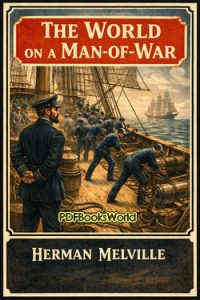
White-Jacket; or, The World in a Man-of-WarbyHerman Melvilleis a vivid maritime novel based on the author’s experiences serving aboard a United States naval vessel. Combining adventure, satire, social criticism, and autobiographical realism, the book presents life aboard a warship as a complete floating society governed by rigid hierarchy, brutal discipline, and constant tension.
More than a sea adventure, the novel becomes a powerful critique of institutional cruelty and the dehumanizing effects of military authority.
A Sailor Named White-Jacket
The narrator, nicknamed White-Jacket because of the unusual white coat he wears aboard ship, serves on a massive naval frigate crowded with sailors, officers, marines, and strict regulations.
Through his observations, readers experience the exhausting routines, dangers, punishments, and social divisions shaping daily life at sea.
The ship functions almost like a miniature world isolated from ordinary society, where every movement is controlled by rank, discipline, and fear of punishment.
White-Jacket himself remains observant, thoughtful, and increasingly critical of the harsh treatment inflicted upon sailors by naval authority.
The Floating Society Within the Warship
White-JacketA reflective sailor whose experiences reveal the realities and injustices of naval life.The OfficersFigures enforcing discipline, hierarchy, and military order aboard the vessel.The SailorsMen enduring danger, labor, confinement, and physical punishment within the naval system.The Ship ItselfA symbol of institutional authority, isolation, and collective human existence.
Melville fills the novel with detailed portraits of personalities, routines, conflicts, and emotional struggles aboard the ship.
The Brutality of Naval Punishment
One of the novel’s most important elements is its condemnation of flogging and physical punishment within the navy. Melville portrays these practices as degrading, cruel, and destructive to human dignity.
The fear of punishment shapes the emotional atmosphere of the ship, influencing relationships between officers and sailors alike.
Melville’s criticism was so influential that the novel contributed to public opposition against flogging in the United States Navy.
The story therefore functions not only as fiction, but also as social protest.
Major Themes Running Through the Novel
Authority and OppressionThe novel examines how rigid systems of power can dehumanize individuals.Life as Collective ExperienceThe warship becomes a floating society where people depend upon one another for survival.Freedom and ConfinementSailors experience physical movement across oceans while remaining socially imprisoned by discipline.Human Dignity and ResistanceMelville emphasizes the emotional and moral importance of preserving humanity within harsh institutions.
Melville’s Blend of Realism and Social Criticism
White-Jacketdiffers from Melville’s later symbolic masterpieces because of its strong grounding in direct observation and realistic detail. The novel vividly captures shipboard labor, naval customs, weather, hierarchy, and maritime culture.
At the same time, Melville’s philosophical and psychological interests already appear clearly. He transforms the ship into a symbolic world reflecting broader questions about power, obedience, and social organization.
The result feels both documentary and deeply literary.
Why the Novel Still Feels Relevant
Modern readers continue findingWhite-Jacketcompelling because its concerns about institutional authority, human dignity, and abusive systems remain highly relevant.
The novel also offers an extraordinary portrait of nineteenth-century naval life while anticipating later critiques of bureaucracy, militarism, and social control.
For readers interested in maritime fiction, social criticism, military history, and classic American literature, this novel remains vivid, humane, and intellectually powerful.
THE JACKET.
It was not a
very
white jacket, but white enough, in all conscience, as the sequel will show.
The way I came by it was this.
When our frigate lay in Callao, on the coast of Peru—her last harbour in the Pacific—I found myself without a
grego
, or sailor’s surtout; and as, toward the end of a three years’ cruise, no pea-jackets could be had from the purser’s steward: and being bound for Cape Horn, some sort of a substitute was indispensable; I employed myself, for several days, in manufacturing an outlandish garment of my own devising, to shelter me from the boisterous weather we were so soon to encounter.
It was nothing more than a white duck frock, or rather shirt: which, laying on deck, I folded double at the bosom, and by then making a continuation of the slit there, opened it lengthwise—much as you would cut a leaf in the last new novel. The gash being made, a metamorphosis took place, transcending any related by Ovid. For, presto! the shirt was a coat!—a strange-looking coat, to be sure; of a Quakerish amplitude about the skirts; with an infirm, tumble-down collar; and a clumsy fullness about the wristbands; and white, yea, white as a shroud. And my shroud it afterward came very near proving, as he who reads further will find.
But, bless me, my friend, what sort of a summer jacket is this, in which to weather Cape Horn? A very tasty, and beautiful white linen garment it may have seemed; but then, people almost universally sport their linen next to their skin.
Very true; and that thought very early occurred to me; for no idea had I of scudding round Cape Horn in my shirt; for
that
would have been almost scudding under bare poles, indeed.
So, with many odds and ends of patches—old socks, old trowser-legs, and the like—I bedarned and bequilted the inside of my jacket, till it became, all over, stiff and padded, as King James’s cotton-stuffed and dagger-proof doublet; and no buckram or steel hauberk stood up more stoutly.
So far, very good; but pray, tell me, White-Jacket, how do you propose keeping out the rain and the wet in this quilted
grego
of yours? You don’t call this wad of old patches a Mackintosh, do you?——you don’t pretend to say that worsted is water-proof?
No, my dear friend; and that was the deuce of it. Waterproof it was not, no more than a sponge. Indeed, with such recklessness had I bequilted my jacket, that in a rain-storm I became a universal absorber; swabbing bone-dry the very bulwarks I leaned against. Of a damp day, my heartless shipmates even used to stand up against me, so powerful was the capillary attraction between this luckless jacket of mine and all drops of moisture. I dripped like a turkey a roasting; and long after the rain storms were over, and the sun showed his face, I still stalked a Scotch mist; and when it was fair weather with others, alas! it was foul weather with me.
Me?
Ah me! Soaked and heavy, what a burden was that jacket to carry about, especially when I was sent up aloft; dragging myself up step by step, as if I were weighing the anchor. Small time then, to strip, and wring it out in a rain, when no hanging back or delay was permitted. No, no; up you go: fat or lean: Lambert or Edson: never mind how much avoirdupois you might weigh. And thus, in my own proper person, did many showers of rain reascend toward the skies, in accordance with the natural laws.
But here be it known, that I had been terribly disappointed in carrying out my original plan concerning this jacket. It had been my intention to make it thoroughly impervious, by giving it a coating of paint, But bitter fate ever overtakes us unfortunates. So much paint had been stolen by the sailors, in daubing their overhaul trowsers and tarpaulins, that by the time I—an honest man—had completed my quiltings, the paint-pots were banned, and put under strict lock and key.
Said old Brush, the captain of the
paint-room
—“Look ye, White-Jacket,” said he, “ye can’t have any paint.”
Such, then, was my jacket: a well-patched, padded, and porous one; and in a dark night, gleaming white as the White Lady of Avenel!
A MAN-OF-WAR LIBRARY. Nowhere does time pass more heavily than with most men-of-war’s-men on board their craft in harbour. One of my principal antidotes against ennui in Rio, was reading. There was …
KILLING TIME IN A MAN-OF-WAR IN HARBOUR. Reading was by no means the only method adopted by my shipmates in whiling away the long, tedious hours in harbour. In truth, many of them could not have read,…
SMUGGLING IN A MAN-OF-WAR. It is in a good degree owing to the idleness just described, that, while lying in harbour, the man-of-war’s-man is exposed to the most temptations and gets into his saddest …
A KNAVE IN OFFICE IN A MAN-OF-WAR. The last smuggling story now about to be related also occurred while we lay in Rio. It is the more particularly presented, since it furnishes the most curious eviden…
PUBLISHING POETRY IN A MAN-OF-WAR. A day or two after our arrival in Rio, a rather amusing incident occurred to a particular acquaintance of mine, young Lemsford, the gun-deck bard. The great guns of…
THE COMMODORE ON THE POOP, AND ONE OF “THE PEOPLE” UNDER THE HANDS OF THE SURGEON. A day or two after the publication of Lemsford’s “Songs of the Sirens,” a sad accident befell a mess-mate of mine, on…
AN AUCTION IN A MAN-OF-WAR. Some allusion has been made to the weariness experienced by the man-of-war’s-men while lying at anchor; but there are scenes now and then that serve to relieve it. Chief am…
PURSER, PURSER’S STEWARD, AND POSTMASTER IN A MAN-OF-WAR. As the Purser’s steward so conspicuously figured at the unsuccessful auction of my jacket, it reminds me of how important a personage that off…
NEVERSINK. While lying in the harbour of Callao, in Peru, certain rumours had come to us touching a war with England, growing out of the long-vexed Northeastern Boundary Question. In Rio these rumours…

THE BAY OF ALL BEAUTIES. I have said that I must pass over Rio without a description; but just now such a flood of scented reminiscences steals over me, that I must needs yield and recant, as I inhale…

A Mysterious Influence That Changes Everything The Master SpiritbySir William M…
Read more

A Stirring Conclusion of Adventure, Honor, and Personal Triumph Second to None:…
Read more

A Quiet Community Hides a Dangerous Secret The North Shore MysterybyHenry Fletc…

Read more